Pages

Tuesday, July 17, 2012

The Motivated Camera

When writing a scene, a lot must be considered, including lighting, color, framing and composition, and more. But something that is not initially obvious -- and just as important as any other element -- is camera movement. Motivated camera movement is integral to the successful execution of the scene. Just like framing, movement must have a purpose -- it can't be just thrown in, attempting to achieve something that it can not.


Want to dramatically reveal something? Use a nice slider shot. Want to increase the tension in a scene? Try some frantic handheld movement. For anything you want to say visually, you can bet there is a way to show it with motion.


One great example of this is found in Magnolia. The control of the camera is top notch, and the blocking of actors seems almost impossible to me. The scene begins from behing the main characters as the enter a building. As the tension in the scene rises, we are brought seamlessly to the front of the characters, sharing in their increasing emotion. Through complex twists and turns, we feel as if we are right there in the scene with them -- both physically and emotionally. Take a look for yourself. The video below should be set to automatically start at the correct scene. If not, just skip to 2:27.


Monday, July 16, 2012

Scene Analysis: There Will Be Blood's Baptism Scene


For my scene analysis, I'll be taking a look at one of my favorite film scenes of all time -- and yes, it is from PT Anderson's There Will Be Blood. I have attached the entire scene above, but I will attach each shot below along with an analysis of that shot.


This scene begins with Eli Sunday speaking in front of the congregation of the Church of the Third Revelation. This low-angle close-up establishes Eli as a character with power in the scene. He is backlit by the cross-shaped window, giving him an almost holy aura. The bright, warm color palette also lends to this "holy" feel.


Next, we see the congregation. Immediately, we see a change of color temperature from warm to cool. This represents the change in feeling of the characters in the frame. In the previous image, Eli is speaking with great passion, thus being illuminated with a warmer hue. When we move to this second shot, we see the cool mood reflected by Daniel Plainview's (right) frustrated emotion. The use of shallow depth-of-field establishes Bandy (left) and Plainview (right) as the other characters that this scene focuses on. The characters are placed in the left and right third, with the middle of the frame being filled by the remainder of the congregation. Plainview is clearly not happy to be here.


The scene cuts back to Eli after he asks if anyone in the congregation seeks salvation.


Daniel reluctantly raises his hand and stands up. The camera tilts up to follow his movement, resulting in a low-angle shot. This represents Daniel's progression in power in the scene. He seems larger now.


Daniel joins Eli at the pulpit. He is now sharing in the warm light that Eli was previously occupying alone. Daniel's slight rise in power is immediately taken away again as he kneels to the ground, below Eli. Daniel is placed in the dead center of the frame, under the cross. This slightly awkward positioning, paired with the very wide angle lens, gives the audience an uneasy feeling, and foreshadows the uncomfortable dialogue that is to come.


Here, we see Daniel after Eli has urged him to confess his sins in front of the congregation. He is still positioned in the middle of the frame, but this time we are moved to a close-up as the emotion gets more intense. The camera is head-on, representing his relatively low position in the scene.


Next we move to a low angle of Eli, re-establishing him as the character with power in the scene. This is juxtaposed with his hands clasped together in prayer, eyes looking to the heavens at a being higher than himself. Even though he claims to worship God, it is clear that he only seeks to worship himself. Eli is also positioned in the middle of the frame, continuing the uneasy feeling.


Above, we see the transformation of Daniel's emotion. After being forced to proclaim that he has abandoned his son, he unleashes ages of pent-up anger toward Eli, himself, and the world. The camera lingers on him for a while to let the audience absorb the emotion.


We move back to an even closer shot of Eli as he revels in his pride. He has begun to control Daniel, something that he has wanted since the beginning of the film. This big close-up represents this drastic increase in emotion, and the camera is brought even lower to show his sense of growing power.


Next, we go back to the wide show, but this time, the congregation is eliminated from the frame, showing the intimacy of Eli and Daniel's exchange. Eli towers above Daniel and begins slapping him repeatedly in the face. From earlier scenes, we learn that this is a common practice in his church, but it is obvious that he adds in a little extra violence just for Daniel.


We now move to a medium close-up of Daniel as he is baptized. He looks straight up in a submissive fashion, but mutters "there's the pipeline" as soon as he leans back up, turning the act of baptism into a strictly selfish endeavor (Bandy has agreed to only sell his land to Daniel for a pipeline if he is baptized).


Daniel rises, reestablishing his power in the scene, and moves out from under the cross, symbolizing his betrayal of the act of baptism. He moves to Eli, now taller than him for the first time, and shakes his hand. We can't hear what he is saying to Eli, but we can easily tell that it's probably somewhere along the lines of "I will kill you in your sleep."


We now move from the previous wide shot to a medium shot as Daniel walks into the congregation. We can still see the distraught face of Eli in the background. This medium shot eventually turns into a close-up, bringing the focus back to Daniel. The lighting also gets darker and darker as Daniel moves closer to the camera, further symbolizing his emotional transition into darkness.


The final shot in the scene is of Mary Sunday (Eli's younger sister) hugging Daniel. This eerie shot juxtaposes the love of one Sunday child with the utter hatred of another. It is also a symbolization of the innocence of Mary versus the experience of Daniel, a common theme in dramas and westerns in particular.

Overall, this incredibly powerful scene shows the depth of PT Anderson's filmmaking abilities. We see a clear character transformation in both Eli and Daniel, and through visual style and tact, Anderson is able to enhance his brilliant storytelling.

Wednesday, July 11, 2012

Destination


It's always hard to describe the details of exactly where you want to end up in your career. Sometimes it's because you don't really know yet, and other times it's because you don't want to be disappointed if you can't attain the seemingly unobtainable goals you've set for yourself. This is a very prevalent issue in the entertainment industry (and film in particular). The chances of "making it big" are one in a million, and there are thousands of others out there that have more experience.

So, now that I've gotten that out of the way, what are my goals in this seemingly over-saturated industry? Well, as you can probably glean from my previous posts, I am a fan of Paul Thomas Anderson. A big fan. A very big fan. He is one of the true auteurs of our time, and, in my opinion, of of the greatest directors of all time. Not only does he direct amazing films -- he writes them too. He says that he will never direct anything that he didn't write, and I feel that this is the sign of a truly great storyteller. He sees his films through from beginning to end, and his passion jumps out of the screen. This is what I want to do. I want to write and direct stories that matter. Hopefully, these will also eventually make money, but if I can tell a story worth telling -- something that emotionally affects audiences and makes them think -- then I have succeeded. I want to make movies that people talk about when they leave the theatre.

My goals in this class are stepping stones to my ultimate goals. I have a true passion for visuals, and I love working with the camera. This class will help me hone these skills and develop an understanding of the filmmaking process.

I hope that I can one day make films like Paul Thomas Anderson and other great auteurs. I want my passion to be shown to others through my images and through my stories.

Tuesday, July 10, 2012

My Style


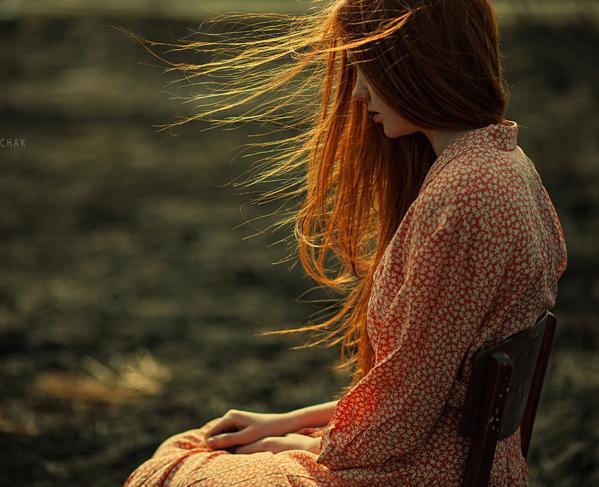
If I were to describe my style in a few short adjectives, I'd describe it as simple, colorful, and intimate. The image above, a photograph by Jaroslav Monchak, is a great example of all three.

When I say "simple," I don't mean without depth. I firmly believe that depth can be found in simplicity, and that nothing should appear on-screen unless it has a purpose. In the above photo, the focus is obviously meant to be primarily on the female, and secondarily on her environment. She is beautifully lit from the front, adding a warm light to her hair and lap, leading the eye directly to her porcelain skin and fiery red hair. She is also wonderfully composed, sitting in the right third with her head occupying the intersection of the top and right third. There is a shallow depth of field, keeping the background soft and mysterious, almost looking like an endless ocean.

As far as color goes, I usually am drawn to a more muted color palette, with cool darks/midtones and warn highlights, which is very present in this image. Although her hair is fairly saturated, it complements the dulled tones of the background and her skin perfectly. I would definitely say that my color preference is quite similar to Wes Anderson's. The below picture is from his most recent film, Moonrise Kingdom.


Now, onto intimacy. No, I don't necessarily mean "romantic" imagery in the general sense. I mean images that invoke something in the viewer. Just like the objects on screen needing to have a purpose, the entire mise-en-scene needs to have a purpose as well. Are you trying to portray sadness? Hope? This should be answered not only by the dialogue in the scene, but my the visual aesthetics as well. This photo by Jacob Sutton is a great example of capturing amazing emotion.


As a final example, take a look at the teaser trailer for Paul Thomas Anderson's newest film, The Master (yes, it was in my previous post, but it's just way too good). It encompassed everything I've mentioned above and more. Every single shot tells a story of its own. Each frame's lighting, composition, form, movement, and tone evoke an overarching emotion of mystery, beauty, and slight unease. Not to mention the writing and directing being absolute perfection. This is exactly my style, summed up in the best 1 minute and 40 seconds of my year so far. Enjoy. 


Monday, July 9, 2012

Ten Things About Me

I feel like the best way to describe a film major is with films. These are some of my favorite movies in no particular order (except for There Will Be Blood -- that's my favorite movie of all time). Also, number 10 hasn't been released, but it has to be the best trailer I've seen in a very long time.

1. There Will Be Blood


2. A Clockwork Orange


3. 2001: A Space Odyssey


4. Magnolia


5. Moon


6. Tree of Life


7. Moonrise Kingdom


8. Amour


9. Blade Runner


10. The Master (It's not out yet, but oh my lanta does it look amazing)